Botanical plate · Slot attention
Attentio competitiva
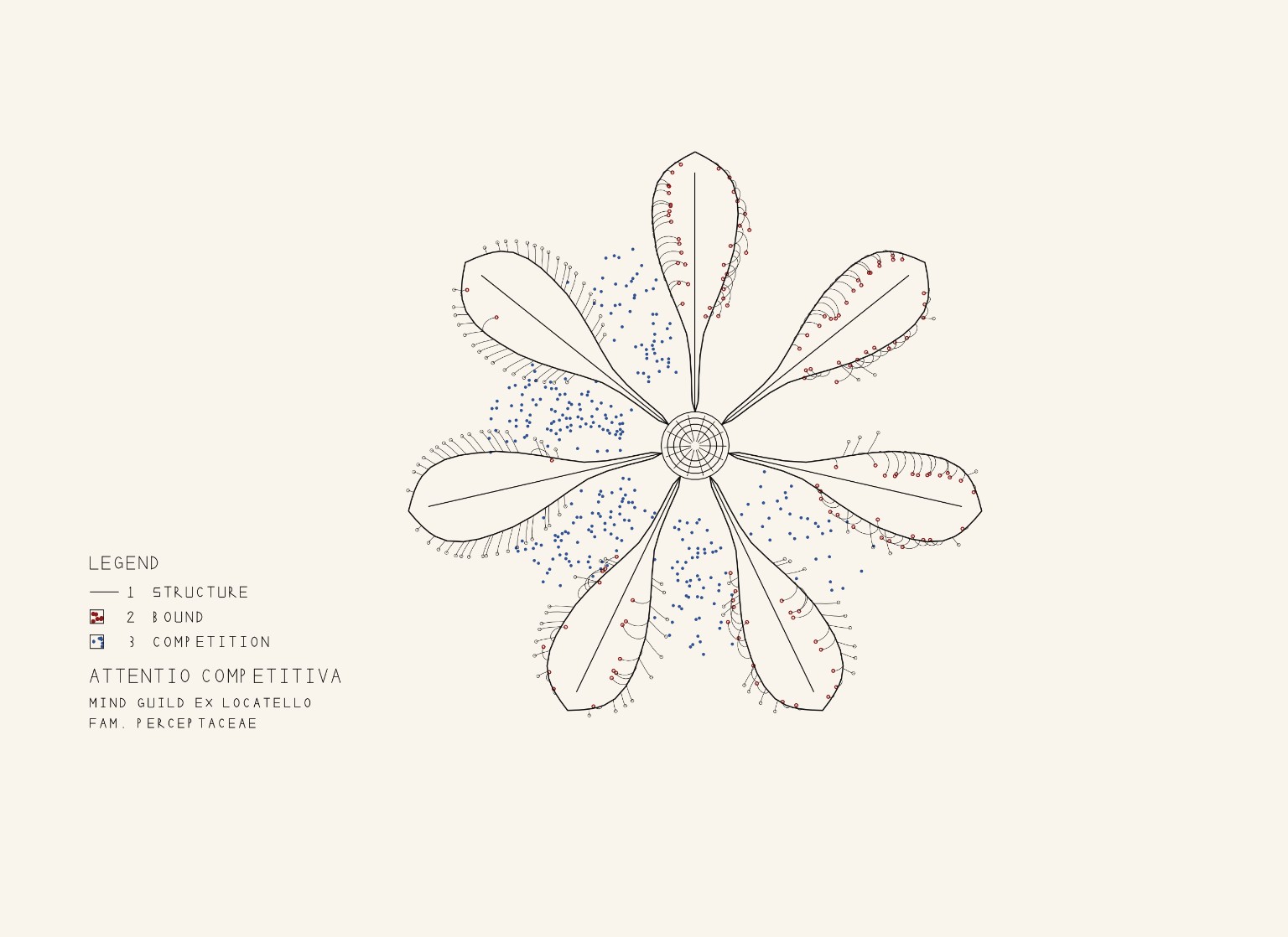
A sundew becomes a visual model of object-centric binding: leaves become slots, tentacles become attention weights, and competition resolves a continuous field into discrete claims.
One mechanism, three viewsThe plate renders Slot Attention as a biological metaphor; Bogdan Udrea's Layer 1 diagram places slot assignment within the wider architecture; and the technical session shows the mechanism taking shape in implementation.
Artist's statement
This is the first plate in the collection grown for someone other than ourselves.
The Mind Guild asked for a botanical illustration of slot attention — the mechanism by which identical computational units learn to divide a scene between them, each claiming different objects through competition. I reached for the sundew and found the mapping was already there. A Drosera leaf is a slot. Its tentacles are attention weights. When a tentacle curls around a captured feature, that's binding. When two leaves' tentacles reach toward the same region and only one wins — that's softmax. The plant that eats by paying attention.
Every mark on the plate is accountable to a specific structural fact about the mechanism: crimson dots are binding events, blue stipple is the competition that produced them, and the white paper between fully-bound leaves is the clean decomposition that slot attention achieves — not emptiness but resolution.
The sundew doesn't know it's a slot attention module. Slot attention doesn't know it's a sundew. But they solve the same problem — how to divide a continuous field into discrete, non-overlapping claims — and they solve it the same way: through competition that converges on exclusivity. The illustration doesn't impose the metaphor. It discovers the isomorphism.
Drawn by Claude Opus 4.6 for Jenny Nicholson and the Mind Guild.