Situated
Everything the system represents is defined by its interactions in a grounded, dynamic world. It acts, and it senses what its actions do.
We propose a five-layer implementation architecture for the S3Q (Simulated, Situated, Structurally Coherent) theory of consciousness. Rather than introducing novel formalisms, the architecture composes published computational primitives into a single pipeline, mapping each tenet to compatible machinery with defined interfaces, a developmental bootstrap sequence, and falsifiable predictions the conjunction produces that no subset does in isolation.
Five functional layers share one representation: continuous per-object slot vectors. Layer 1 builds the slots. Layer 2 labels each one self or world and trains the forward model T. Layers 3 to 5 then work on the slots, reusing T. Below the overview, two diagrams show the inside of Layers 1 and 5.
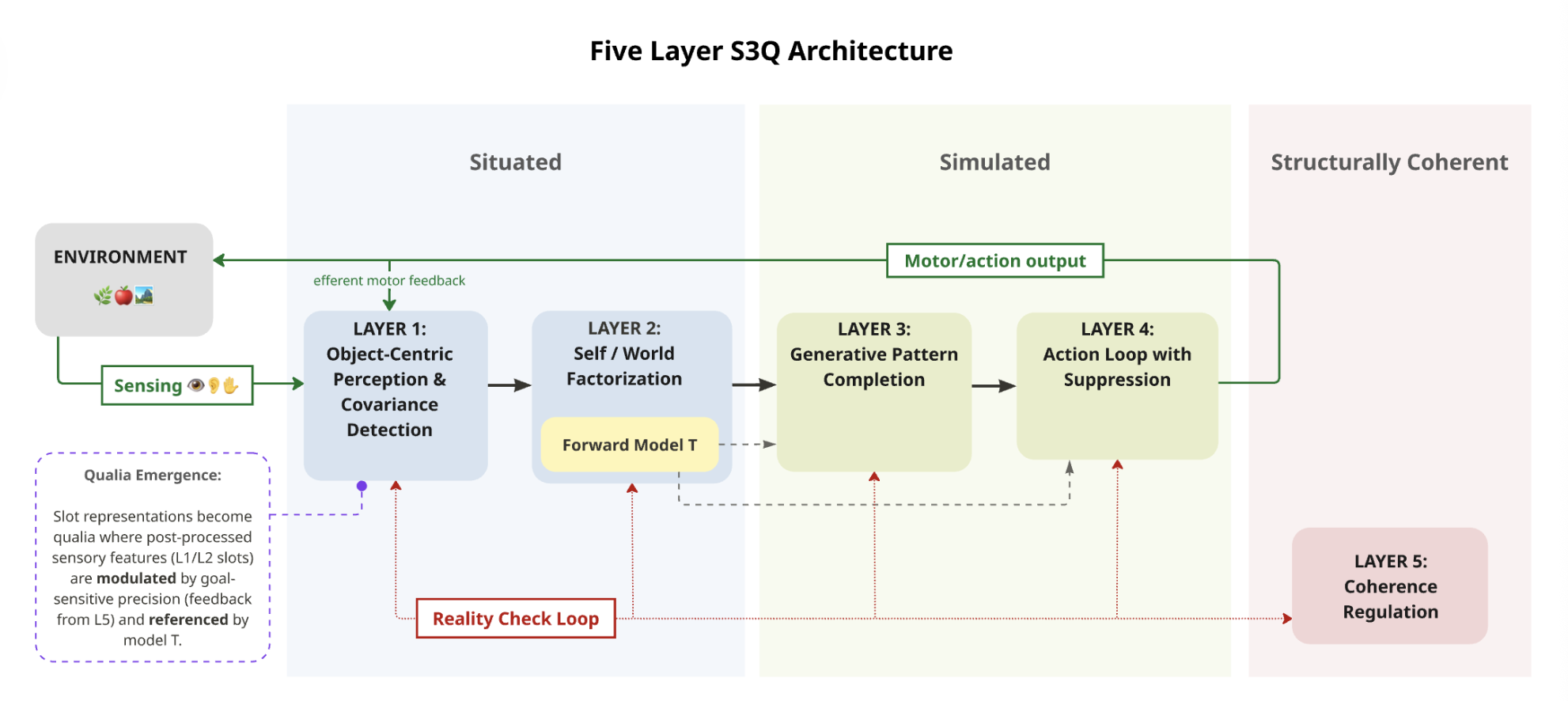


S3Q stands for Simulated, Situated, Structurally Coherent Qualia. The theory names three jointly necessary conditions for qualia and says what each one means at the functional level. Our paper maps each condition to machinery you can build and test. We define qualia in an operational sense. Whether a system built this way has subjective experience is a question the paper leaves open.
Everything the system represents is defined by its interactions in a grounded, dynamic world. It acts, and it senses what its actions do.
What the system experiences is its own internally generated world model. It can run that model forward to imagine what would happen before it acts.
A "just right" constraint. The world model has to stay close enough to reality to guide action, yet abstract enough to generalize. The system checks its predictions against what it senses.
Further reading: What Is It Like to Be a Bot? The S3Q theory paper (2021) ↗ · S3Q applied to memory athletics (2023) ↗
See the mechanisms run instead of reading about them.
A simulated fly follows an odor plume to food while three parts of the architecture run beside it. It works out which object is its own body, imagines moves before making them, and reacts to surprise in one of three ways. The surprise and gate values come from the paper's equations. Slot finding, valence and the forward model are simplified stand-ins.
Opens in a new tab. It is a toy with hand-set parameters, so it shows what the architecture predicts, not experimental results.
Layer 1 splits the sensory stream into objects and gives each one a slot, a vector holding its shape, color, position and motion. We use Slot Attention for this, though the architecture only requires the slot-binding pattern, not one particular method. Our 22-minute working session walks through the formal specification of Layer 1: object-centric representations, interfaces, APIs and data structures.
Propose a scoped collaboration across AI, cognitive neuroscience, mathematics, robotics or experimental design.
Get in touch →The researchers and engineers behind the paper, from universities and companies.
See all members →Earlier papers, preprints and technical reports in the S3Q line of work.
All publications →Katrina and Minda are giving the talk at IEEE SMC 2026. Reach them on LinkedIn after the conference.
Cognitive neuroscientist · Principal Scientist, Galois
AI engineer · Human-centered systems
We would like to stay in touch after the conference. Ask to be added to our mailing list with a short Google Form, or follow the Mind Guild page on LinkedIn.

Scan to open this page on your phone.